Last updated: November 20, 2025
As an employer, your employees’ safety on the job is your number one priority. But here’s the reality: workplace safety isn’t always common sense, and your employees might not automatically know how to perform their jobs safely. For that, you need a workplace safety program that empowers them to work with confidence.
A well-designed safety program benefits your business in many ways beyond just protecting your people. It can help you reduce your workers compensation premium by preventing injuries and managing claim costs.
There are four foundational elements every successful safety program must have. Whether you’re just getting started or planning improvements to your existing program, these foundations will set you up for success.
Why your business needs a workplace safety program
Before we dive into the details, let’s level set on the business case for workplace safety.
The true cost of workplace injuries
Work comp is the most commonly accessed line of insurance. Work-related injuries are both common and expensive. Understanding these costs is crucial for any business owner considering their safety investment.
- Average work comp claim cost: $47,316
- Median number of days away from work: 10 (but can be much higher)
- Injured workers who never return to work: 21%
The financial impact of frequent workplace injuries extends far beyond the initial medical bills. Additional costs to the business include:
- Increased insurance premium: Injuries impact your premium calculation
- Lost productivity: Work stops for investigations and incident response
- Overtime costs: Other employees cover additional duties and shifts
- Management distraction: Leadership attention shifts from productive activities to crisis management
- Decreased morale: Employees feel less safe at work
- Higher turnover: Employees leave for safer environments, creating recruiting and training costs
- Reduced efficiency: Inexperienced replacement employees perform at lower levels
- Regulatory scrutiny: Poor safety records invite additional compliance challenges
☑️ The bottom line: By improving workplace safety and preventing injuries, you can protect your people and reduce these costs. OSHA data reveals employers with top-tier safety programs have 52% fewer lost-time claims than industry averages, directly impacting their experience modification rates and overall insurance costs.
How safety programs reduce work comp premiums
How exactly does a safety program help you control your work comp costs? It’s all about the e-mod.
Work comp premiums follow a straightforward formula:
Payroll × classification rate × e-mod = premium
Your experience modification rate (e-mod) is calculated based on your company’s claims history compared to other similar businesses. A company with a 1.2 e-mod will pay about 20% more for its work comp premium, while one with a 0.8 e-mod will pay about 20% less.
Your e-mod uses three years of claims data, excluding the current and prior policy years. A claim today won’t affect your e-mod for 1-2 years, and the impact will resonate 4-5 years post-incident. This means the safety investments you make today will have long-term financial benefits.
Get the full breakdown of how your e-mod is calculated and strategies to improve it: E-Mod Explained: What It Costs You and How to Improve It >

The four foundations of a successful safety program
What does a safety program include?
“A safety program is a set of documented expectations that employers have in place to help reduce injuries and illnesses in the workplace,” explained Brad Minor, MEM Senior Safety and Risk Consultant.
“It does not need to be terribly complicated. In fact, the most effective ones are simple,” he continued. “The best way to put together a safety program is to look at the work that you do and address the risks and exposures that employees face every day.”
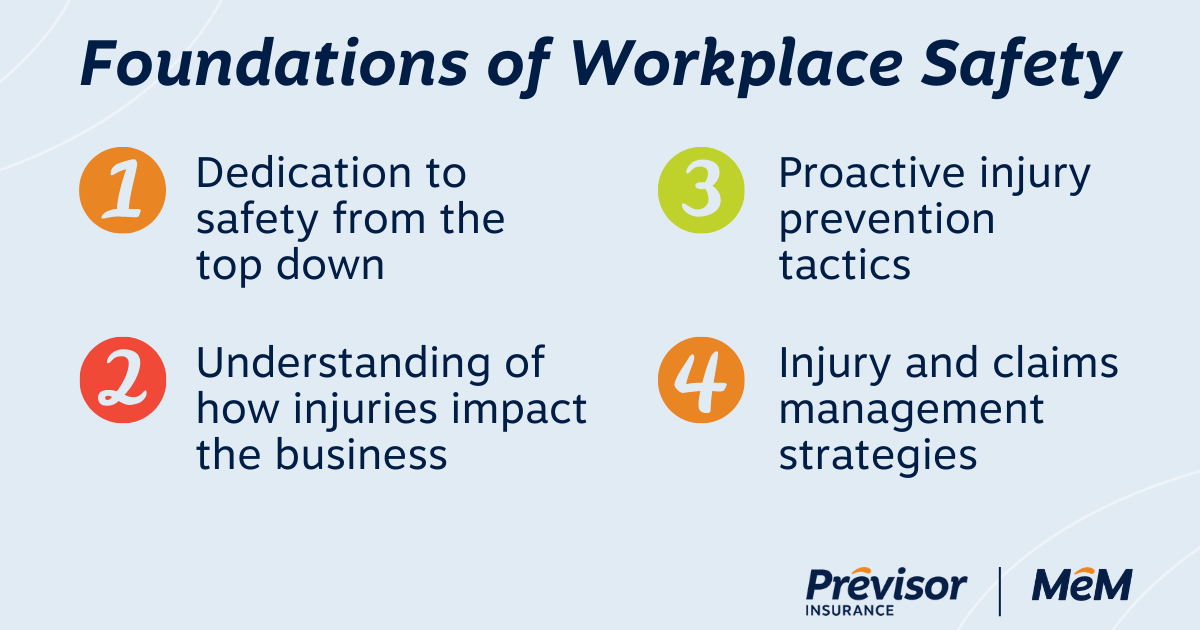
There are four foundational elements of a workplace safety program:
- Dedication to safety from the top down
- Understanding of how injuries impact the business
- Proactive injury prevention
- Injury and claims management
Let’s walk through each of these areas to uncover exactly what they entail and best practices to get them right.
Foundation 1: Leadership commitment to safety
Safety efforts will fail without real support from your organization’s leadership. Company leaders must be prepared to implement safety policies and then allocate company time and resources to train employees.
Start by finding a safety champion on your company’s leadership team. Then, work together to get the buy-in you need.
Support safety teams and advocates
Don’t mistake leadership commitment for a safety program that’s exclusively top-down. Employees must be engaged at all levels of the company for your program to work.
“Safety is not separate from engagement,” remarked Kevin Burns, author of PeopleWork: The Human Touch in Workplace Safety. If you hire a safety professional or assemble a safety committee, be prepared to act on their recommendations. If a change isn’t possible right away, develop a clear plan for future improvements.
Safety rules are effective when employees understand the reasons behind them and how the policies benefit them. Clearly communicating these messages supports long-term compliance and buy-in.
Leadership must also be prepared to enforce safety rules. “There should be corrective action in place,” explained Minor, “and you want to keep a record of that in case you need to take adverse action down the line.”
⏬ Download: Disciplinary Action Form >
Disciplinary action is a last resort for individuals who are truly acting in bad faith. But it’s equally important to recognize and reward employees who consistently follow safety protocols.
“Encourage employees when they’re being safe in the workplace. Sometimes, incentives can include gift cards, t-shirts, and those types of things,” said Minor. “But it doesn’t have to be physical. Simple acknowledgement and praise go a long way for employees.”
📍 Read next: Safety Week Starter Kit >

Invest in safety
It’s this simple: personal protective equipment, safer machines, and better equipment cost money. You don’t have to allocate millions to your safety program on day one, but your plan should include a budget.
Essential safety investments:
- Personal protective equipment (PPE)
- Machinery upgrades and safety equipment
- Facility improvements and hazard elimination
- Training programs and educational materials
- Employee recognition and incentive programs
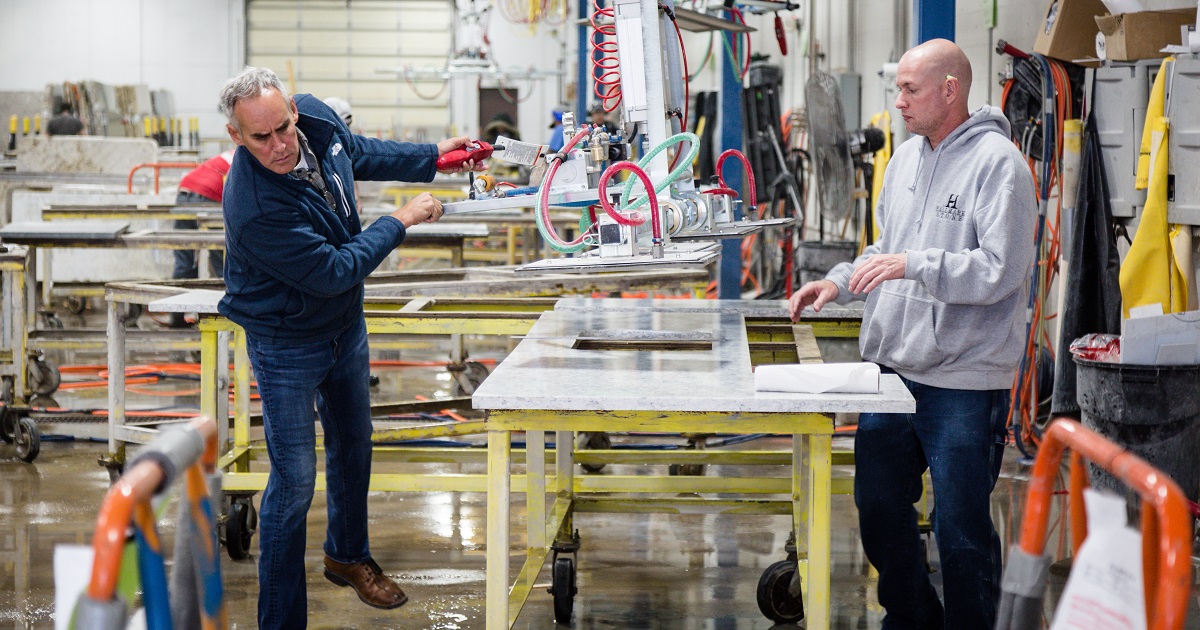
➡️ Here’s an example: Koonse Glass Company recognized an opportunity to reduce employees’ exposure to overexertion risk by investing in a vacuum lift to help employees transport heavy glass materials. The result? Their $32,985 investment yielded an estimated return of more than $96,000 over five years. You don’t see this kind of ROI from maintaining business as usual – you have to spark change and invest in your employees’ safety.
Checklist: Leadership commitment to safety
| ✅ | Identify a safety champion on your leadership team |
| ✅ | Commit to acting on safety committee recommendations |
| ✅ | Create accountability measures for safety performance |
| ✅ | Establish recognition programs for safe behavior |
| ✅ | Allocate budget for safety investments (PPE, equipment, training) |
Foundation 2: Understanding the costs of neglecting safety
Neglecting workplace safety can result in the ultimate cost: One of your employees could be seriously injured or killed. It’s also important to understand the financial costs associated with your work comp policy and how your workplace safety programs affect them.
Did you know? You can take steps to control your work comp premium. We break them down in this guide: 4 Proven Ways to Reduce Your Workers Compensation Costs >
Analyze your claims history
How many claims has your company had in the past five to ten years? What were the causes and how much did they cost?
This analysis helps you identify patterns and prioritize prevention efforts. But the output is only as good as the data you put in. That’s why it’s crucial to conduct thorough incident investigations after every injury.
Key steps in claims analysis:
- Review all claims from the past 5-10 years
- Identify common injury types and causes
- Calculate total costs, including hidden expenses
- Look for seasonal or departmental patterns
- Prioritize prevention efforts based on frequency and severity
Understanding how and why injuries occurred gives you the best chance of protecting other employees.
📍 Read next: Frequency vs. Severity: The Impact of Claims Big and Small >

Maximize your policy’s value
Many organizations think of work comp insurance as a bill to pay. But with the right partners, your policy is a valuable asset. Your insurance agent and your work comp carrier want the same thing you do: to prevent workplace injuries and keep costs low.
For example, you might know your e-mod – but do you know how a claim will affect it and your premium? What impact would you see after just one year injury-free? Your carrier or agent can help you understand your power to control your e-mod and reduce your premium.
“We have tools to forecast an experience modifier,” explained MEM Director of Safety and Risk Services Brandon Jones. “It can give a construction company an idea of what their premium may be a year from now, if claims continue at the same pace.”
Insurance carriers may offer a variety of value-added programs and services, but you have to know about and use them. For example, at MEM, our policyholders have access to:
- Safety consultation services
- Safety grants to invest in approved purchases
- Medical management experts
- Return to work support
- In-house legal team
Ignoring these programs means leaving resources, support, and money on the table.
📍 Read next: How to Measure the Total Value of a Workers Compensation Policy >
Checklist: Understanding costs and maximizing value
| ✅ | Review claims history and identify patterns |
| ✅ | Build relationships with your agent and work comp carrier |
| ✅ | Research and understand your carrier’s value-added programs |
Foundation 3: Proactive injury prevention
Leadership is on board, and you understand what you have to gain by improving your safety program (or lose by neglecting it). Now it’s time for the heavy lifting.
Workplace safety doesn’t just happen. It takes real, intentional effort. Your staff must devote energy to implementing safety policies and procedures. Most importantly, these initiatives should be strategic and proactive.
“For many businesses, safety has kind of been a reactive piece of what they do – waiting for something bad to happen before changes are made,” explained Elizabeth Prazeres, VP of Advisory Services at Dextra Group. “The more that leaders can foster psychological safety and speaking up, that’s critical to identifying issues before they become an incident.”
Create safety policies and rules
Your safety policies will be most effective if they’re documented and signed by every employee at your company. These documents should outline the rules and the disciplinary consequences for breaking them. Hold employees accountable when you discover unsafe acts or conditions and enforce rules fairly and consistently.
In some situations, work comp laws allow a reduction of an injured worker’s benefits if they knowingly violated a written, trained, and enforced safety rule. Make sure employees understand that penalties could reduce potential benefits by as much as 50% and they can avoid them by following written safety rules.

Top safety rules for any business:
- Incident reporting policy
- Drug and alcohol policy
- Safe driving policies
- PPE policies
- Lockout/tagout procedures
📍 Read next: 8 Must-Have Safety Policies and How to Enforce Them >
Develop safety meetings and training
Conduct regular safety meetings to increase employees’ awareness of key safety issues. Be sure to keep records of when you held meetings, what you discussed, and who attended.
“You just can’t remember it all,” explained Miguel Ramos, co-founder of Limble. “There are many facets that you need to keep tabs on over time…. You have to document those things to be able to measure and follow up.”
Essential elements of effective safety meetings:
- Regular schedule (weekly, monthly, or quarterly)
- Documented attendance and topics covered
- Interactive discussions, not just lectures
- Relevant topics based on your workplace hazards
- Follow-up on action items from previous meetings
Most companies also need machine- and job-specific safety training. This includes focused, documented training on specialized equipment and machines, like presses, saws, and forklifts.
📍 Read next: How to Lead a Safety Meeting: 4 Tips for Success >

Plan safety inspections
Create a schedule for regular inspection of work areas, machines, and equipment. Check your job sites during the workday. Do all employees have the required safety gear? Are they exposed to dangerous mechanical hazards or slippery conditions that could lead to a fall?
Document your activity. How long has it been since someone inspected a specific machine? If you don’t know the date, either it’s been too long, or you’ve done a poor job of documenting your safety inspections.
Safety doesn’t have to be boring. Engage employees with fun activities like workplace safety trivia.
Checklist: Proactive injury prevention
| ✅ | Develop written safety policies signed by all employees |
| ✅ | Establish fair and consistent enforcement procedures |
| ✅ | Schedule regular safety meetings and document attendance |
| ✅ | Implement machine-specific training programs |
| ✅ | Create inspection schedules for all equipment and work areas |
Foundation 4: Injury management preparedness
Despite your safety initiatives, an employee was injured on the job. Now what?
An injury management plan helps you ensure that an injured worker receives quality care while controlling medical costs. If you don’t have a plan, your work comp carrier can help you develop one.
“When somebody is injured, there’s adrenaline flowing; the stress of the moment,” reflected MEM Field Service Manager Terri Sweeten. That’s why it’s crucial to have a documented incident response plan.
Report the injury ASAP
Provide training to all managers so they understand their responsibilities in case of an employee injury. Have an incident reporting policy that requires employees to report all injuries in writing before leaving work for the day. Your business should seek to report all injuries to your insurance carrier within 24 hours.
Prompt injury reporting is crucial to getting your employee the right level of care as quickly as possible. It also helps control claim costs. At MEM, our claims and medical management experts help policyholders use all available resources to treat the employee while managing costs.
“It goes back into getting the employee in with the right care at the right time,” explained Shannon Fox, MEM Claims Operations Manager. “That’s why our triage program is outstanding, because the employer really doesn’t have to be involved in that process. And our goal is to save the employer money at the same time if we can.”
⏬ Download: Incident Reporting Policy | Employee Incident Report Form
Conduct an incident investigation
After getting the injured worker immediate medical care and reporting the injury to your work comp carrier, it’s important to conduct an investigation right away. This process helps you uncover the root cause of the incident to prevent similar events in the future.
Incident investigation best practices:
- Secure the area. Document the circumstances surrounding the injury. Take lots of notes and photos.
- Get witness statements. Talk to employees who were present during the incident while their memories are still fresh.
- Analyze your findings. What changes can you make to keep employees safe in the future?
⏬ Download: Incident Investigation Report | Incident Witness Statement
📍 Read next: Incident Investigation: Preventing Future Injuries >
Direct and support medical care
Employers’ rights to direct medical care vary by state, but to the extent that you can, you should direct your employees’ medical care in case of workplace injury. If you can’t explicitly direct care, you may still be able to specify a provider network or recommend providers if an injured worker asks.
Directing medical care is all about finding top-quality treating physicians and clinics that understand the work comp system. Your insurance carrier likely has a trusted network of providers and can make suggestions if you ask. Often, you can achieve savings on medical costs by seeking treatment within your carrier’s network.
📍 Read next: Directed Medical Care: How to Get Injured Workers Timely and Effective Treatment >
Offer return to work options
Offer light duty options for employees who’ve missed work due to an injury. Returning to work with modified job duties helps your employee maintain their routine, be productive, and recover faster.
“We know that injured workers get better when we return them even when their capabilities are not back to their full job demands,” remarked Lindy Barthel, MEM’s Manager of Medical Services. “It’s such an added way to shorten the timeline, decrease the costs, and make the injured workers feel better.”
Common light duty options:
- Administrative support: Answering phones, filing, organizing and inventorying supplies, greeting customers
- Training and compliance: Cross-training employees, updating procedures
- Safety activities: Conducting inspections, updating safety manuals
- Maintenance: Cleaning and organizing facilities, basic equipment maintenance
Why is it important to offer modified duties? If an employee is performing light duty while recovering, they’re earning a paycheck from you. This decreases the indemnity (lost wages) portion of the work comp claim, reducing its severity and impact on your e-mod.
📍 Read next: Making Modified Duty Work for Your Employee >
If you’re an MEM policyholder, download our Claims Management Kit so you’re prepared to respond to a workplace injury.
Checklist: Injury management plan
| ✅ | Train all managers on injury response procedures |
| ✅ | Establish 24-hour injury reporting protocols |
| ✅ | Identify preferred medical providers in your area |
| ✅ | Create modified duty job options |
| ✅ | Develop clear communication protocols for all parties |

Measuring success and continuous improvement
Track your progress using both leading indicators (what you’re doing) and lagging indicators (what happened). Today’s technology makes measurement easier than ever.
Key metrics to track:
- Lagging indicators: E-mod, injury frequency/severity, work comp costs, lost time incidents
- Leading indicators: Safety meeting attendance, inspection completion rates, near-miss reporting, employee safety suggestions
- Technology benefits: Streamlined processes and efficiencies that reduce claim costs and improve your e-mod
📍 Read next: Return on Safety: Impact of Workplace Safety on Your Business KPIs >
Implementing your safety program: Start today
For businesses of any size, an effective safety program begins with talking to your employees about safety, developing written plans, and promptly reporting injuries to your insurance carrier.
Here are your next steps to get started:
- Assess and plan: Identify risks, evaluate existing safety measures, and get employee buy-in during development
- Integrate with operations: Make safety a part of existing systems rather than a standalone program.
- Start small: Focus on high-impact low-cost improvements and involve employees in creating solutions.
“Health and safety should just be part of the whole integrated process within your business,” explained Gavin Coyle, author of Workplace Safety on a Budget. “You need an integrated system that covers quality, production, cost, and safety…. it all comes together in one system.”
Don’t let resource constraints discourage you. Whether you have five employees or 500, the foundational principles remain the same. Take some time to evaluate your safety efforts. How do you stack up in these four foundational components?
At MEM, we take a practical approach to safety by providing comprehensive resources and easy-to-implement solutions. Our in-house Safety and Risk Services team provides personalized consultation rather than generic, one-size-fits-all programs.
Ready to partner with a work comp carrier that supports your safety initiatives? Ask your agent about a policy with MEM or find an agent near you.
Frequently asked questions: workplace safety basics
You don’t need to allocate millions on day one. Start with basic PPE, essential training, and policy development. Many effective safety investments – like safety meetings, inspections, and employee recognition – require more time than money. Focus on high-impact, low-cost improvements first.
Small businesses actually have advantages in safety program implementation. Communication is easier, changes can be made quickly, and you can get buy-in from everyone at once. The four foundations apply regardless of size – just scale them to your operation.
You may see immediate benefits in employee morale and engagement. From an insurance perspective, remember that e-mod changes reflect a three-year claims history, so premium impacts take time. However, injury prevention starts paying off immediately by helping you avoid costs like lost productivity, inefficiencies, employee attrition, and lower morale.
Not necessarily. Many successful programs are led by existing managers or safety committees. The key is having someone dedicated to maintaining the program, not necessarily someone whose only job is safety.
Leadership commitment is crucial – without it, other efforts will fail. However, you can begin building all four foundations simultaneously. Start with management buy-in, then establish basic policies and training.
Your safety program should include living documents that are up-to-date and relevant to your organization as it operates today. A good rule of thumb is to review and update your safety documents annually at a minimum – or when your operations change significantly.
Resistance often comes from a lack of understanding or feeling excluded from the process. Include employees in developing the program, explain the “why” behind policies, and recognize safe behavior consistently. Make safety about protecting people, not just compliance.
Absolutely. Many safety elements – policies, training, PPE, management commitment – don’t depend on owning your facility. Work with your landlord on facility-related improvements and focus on what you can control directly.