
Updated: April 16, 2026
Key takeaways:
You’ve gathered everyone for your weekly safety meeting. You prepared your topics and printed handouts. But as you start talking, you notice the glazed-over stares. A few people check their phones.
What’s the problem? Decades in the safety business have shown us that the problem usually isn’t what you’re covering. It’s how you’re covering it. When safety meetings feel like a box to check, employees tune out – and if an injury occurs, you’ll wish the message had landed.
The good news is that small changes to how you plan and run your meetings can make a big difference in how your employees enact the safety information you share. Here are our safety experts’ top four tips.
Tip 1: Plan with purpose
Consistency matters, but meeting every Monday isn’t a strategy – it’s just a schedule.
A safety meeting strategy goes beyond scheduling to make sure your top-priority topics are covered. Start by anchoring topics to your team’s needs:
Review your incident reports. Which hazards keep surfacing? Which safety rules are regularly overlooked?
Think about timing. A pre-winter meeting on cold weather preparedness makes sense. A heat stress safety meeting in January? Not so much.
Build a calendar. Map your topics to real, present risks so employees see the relevance every time you meet.
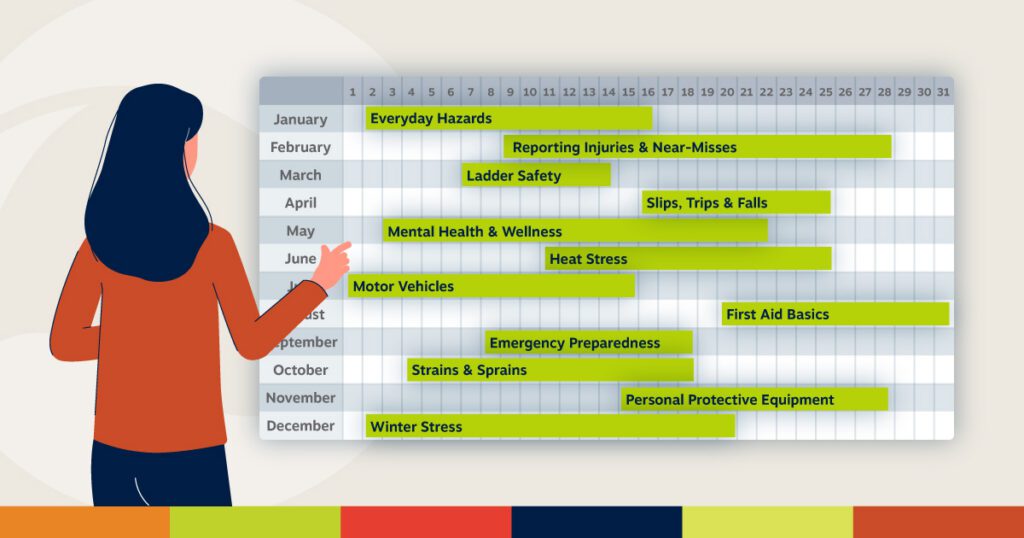
“There are big ticket items that are more frequency- and severity-based within your industry,” summarized Flint Walton, MEM Technical Services and Training Specialist. “I’d focus on those things.”
Toolbox talks are designed for short, focused discussions on a single hazard or practice, and fit naturally into a pre-shift meeting or weekly check-in.
Get started with free toolbox talks in our resource library – written by safety professionals and organized by topic and industry.
Tip 2: Know your audience and adapt your approach
A new hire needs different information than a 10-year veteran. A crew of five has a different dynamic than a room of 50. One of the most common mistakes in safety meetings is using the same format for everyone, every time.
| Audience | Approach |
| New employees | Focus on foundational safety practices. Download our new hire safety toolkit to get started. |
| Experienced employees | Invite them to share expertise with the group. Their buy-in is more likely when they feel like contributors, not just recipients. |
| Small groups | Lean into discussion and hands-on demonstrations. |
| Large groups | Use more structure and deliberate interactive elements to keep people engaged. |
When you adapt to your audience, you show respect for their experience – and they’ll return it with their attention.
📍 Read next: Safety Moment Ideas: 25+ Ready-to-Use Topics for Your Team >
Tip 3: Structure your meetings for engagement, not lectures
The most effective safety meetings aren’t presentations – they’re conversations with a clear structure. Use this three-part formula: Hook, Content, Action.
Hook: Open with something that grabs attention. A recent incident, a surprising statistic, or a direct question to the group – “Who here has had a close call with a ladder?” – signals that what follows is worth paying attention to.
Content: Make it interactive. If you’re covering slip hazards, ask someone to describe a hazard they’ve noticed on the floor. If you’re reviewing an emergency procedure, walk through it step by step rather than just reading it aloud. Real examples and storytelling stick better than bullet points.
“Storytelling is very powerful; it’s very effective,” explained Blaine Hoffman, host of the Safety Pro Podcast. “If you think about it, outside of work, that’s what we’re drawn to – whether it’s movies, whether it’s podcasts, TikTok, YouTube. Storytelling is employed almost exclusively in those cases.”
Action: End with one specific, actionable takeaway. “Watch your step” is too vague to change behavior. “Clear debris from walkways before starting your shift” is something employees can actually do. The more specific the ask, the more likely it is to get done.
📍 Read next: Safety Training That Sticks: Why Microlearning Works >

Tip 4: Make it stick with follow-up and accountability
The meeting doesn’t end when everyone leaves the room. If there’s no accountability for what you discussed, the conversation disappears into the void.
Document what you covered. Keep it simple: The topic, who attended, and any action items. That record creates accountability and becomes useful if questions come up later.
Reinforce the message in daily work. If you covered proper lifting technique on Monday, catch someone doing it right on Tuesday and recognize them for it. Positive reinforcement connects the meeting to the behavior you’re trying to build.
Ask for feedback. “Was this helpful? What should we cover next?” When employees have input on safety meetings, they’re more invested in what comes out of them. To take this idea a step further, consider forming a safety committee to give employees ongoing ownership over safety topics and priorities.
📍 Read next: 7 Signs Your Employee Safety Training Is Actually Working >
Better meetings, safer teams
Effective safety meetings don’t require a dedicated safety manager or hours of prep time – they require intention.
Plan topics around real risks, adapt your approach to your audience, use a structure that invites participation, and follow up to make sure the message sticks. Do those four things consistently, and your safety meetings become one of the most practical tools you have for reducing workplace injuries – and creating a culture built on safety.
Ready to build your safety meeting calendar? Browse free toolbox talks, seasonal safety guides, and more in the MEM safety resource library.
Frequently asked questions: Leading a successful safety meeting
How often should safety meetings be held?
There’s no universal requirement, but most safety professionals recommend at least monthly meetings, with shorter toolbox talks or pre-shift check-ins as often as weekly. Frequency should reflect the risk level of your workplace – higher-hazard environments benefit from more regular touchpoints to keep safety top of mind.
How long should a safety meeting be?
Most safety meetings should run between 10 and 30 minutes. Shorter, focused meetings on a single topic are often more effective than longer sessions that try to cover everything at once. If a topic requires more time, consider breaking it into multiple sessions rather than extending one meeting past the point of engagement.
Who should lead safety meetings?
Safety meetings can be led by business owners, supervisors, safety managers, or team leads – the most important factor is that the person is prepared and credible to the group. Having frontline supervisors lead meetings (rather than the safety manager every time) reinforces that safety is everyone’s responsibility, not just a compliance function.
What topics should I cover in safety meetings?
Start with your incident reports. Recurring hazards and overlooked safety rules are your highest-priority topics. Then, factor in seasonal risks, new equipment or procedures, and regulatory updates relevant to your industry. MEM’s toolbox talk library offers free, professionally written topics organized by industry and hazard type.
Do safety meetings need to be documented?
Yes. While documentation requirements vary by state and industry, keeping a record of what was covered, who attended, and any resulting action items is considered best practice regardless of regulatory obligation. Documentation creates accountability, supports your defense if an injury occurs, and helps you track which topics have been addressed over time.
How do I keep employees engaged during safety meetings?
Use the Hook, Content, Action structure: Open with something attention-grabbing (a question, recent incident, or surprising statistic), make the content interactive through demonstrations or discussion, and close with one specific action employees can take. Adapting your format to group size and experience level also impacts engagement.
What’s the difference between a safety meeting and a toolbox talk?
A toolbox talk is a type of safety meeting – typically shorter (5–15 minutes), informal, and focused on a single topic. They’re common in construction and field environments but work well across industries. Formal safety meetings tend to be longer, more structured, and may cover multiple topics or include training components.
How do I measure whether my safety meetings are effective?
Look for behavioral changes in daily work, not just attendance. Are employees flagging hazards they didn’t notice before? Are the specific actions from your meetings showing up on the floor? Tracking incident trends over time is the most meaningful measure – a well-run safety meeting program should correlate with fewer near-misses and injuries.