
Key takeaways:
If an injury happens at work, how quickly the employee sees a clinician affects both their recovery and the workers compensation claim. Delays leave pain untreated and give a minor injury time to turn into a more complex claim.
For many employers, the fastest option has been the emergency room, but that comes with long waits, high costs, and a day away from work. Telemedicine is an alternative that creates a faster route to care for some injuries.
To sort out where telemedicine fits into work comp, we talked with Jim Harvey, Vice President of Telemedicine Operations at Concentra, and Dr. Eric Gustafson, Associate Director of Medical Operations for Telemedicine at Concentra.
The injuries telemedicine can and can’t treat
Gustafson starts with the limits: “I think the most important thing when you’re practicing telemedicine is being aware of what the limitations are.”
Those limits come down to what a doctor can’t do through a screen: Procedures, certain exams, urgent imaging and controlled substance prescriptions. For everything else, he said he’s willing to assess the patient.
| Often a good fit | Needs in-person care |
| Minor sprains and strains | Stitches |
| Bruises | Dislocations |
| Minor burns, cuts and scrapes | Eye and ear injuries |
| Rashes | Head injuries |
| Tendonitis and repetitive use injuries | Anything requiring a lung exam |
| Bloodborne pathogen exposures (for referral to testing) | Urgent imaging |
| Psychological trauma (for referral to a telemedicine psychologist) | Controlled substance prescriptions |
A doctor can also decide partway through a visit that in-person care is needed.
How a doctor examines an injury through a screen
A telemedicine visit follows the same steps as an in-person exam. The doctor takes a history, examines the injury, and builds a treatment plan, including work restrictions if needed. Doctors can still prescribe medication, order imaging, and make referrals by video.
The exam is the part that changes when a visit is virtual. Gustafson adapts each step:
- Inspect. He looks at the injury on camera, which sometimes requires some camera adjustment. Sensitive body areas aren’t examined by video.
- Palpate. The patient presses on the injured area and describes what they feel.
- Range of motion. The patient moves the injured body part on their own or with their other arm while he watches for the cause of the pain.
- Specialized tests. He shows the patient how to do a test, such as one for carpal tunnel syndrome, and watches them perform it.
Palpation takes the most back-and-forth. “I can’t reach through the computer screen, so I need the patient to do that,” Gustafson said. He asks detailed questions to fill the gap, such as, “So where you’re pushing, do you feel like you’re pushing on the hard bone right there or the area right next to the bone?”
When the visit moves to in-person care
If Gustafson can’t assess function well enough, or can’t do a test he needs, he transfers the patient to in-person care. Patients can also choose to have their follow-up in person. Even with transfers, the majority of patients he sees are treated by telemedicine from start to finish.
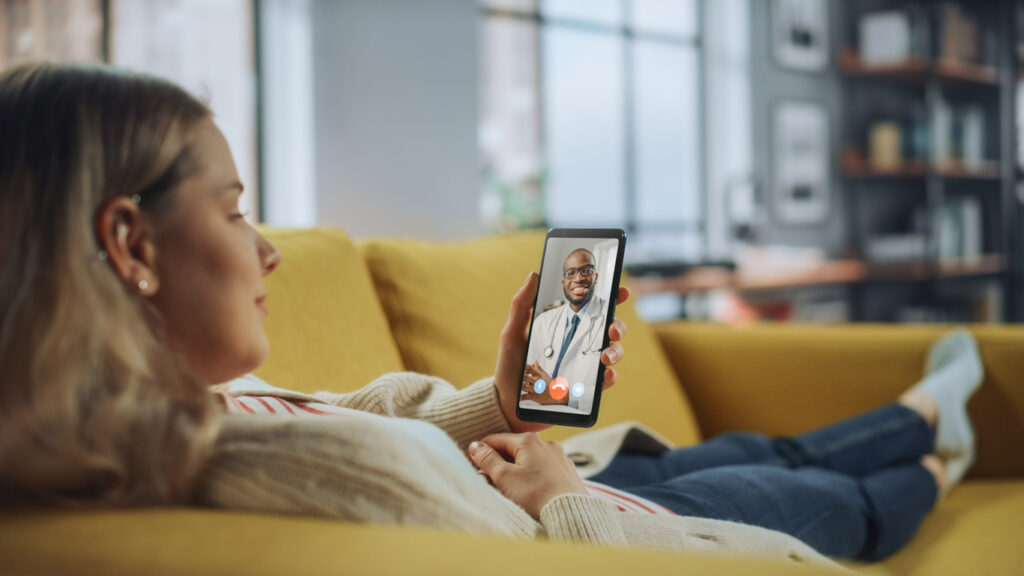
The employee’s side of a telemedicine visit
Employees join through a link on a smartphone, tablet or computer, with both audio and video. First-time users go through a short registration. A care coordinator confirms their information and that the injury is appropriate for telemedicine, then places them in a virtual waiting room until a doctor connects.
Employees can connect from home or from work, including a job site. The space needs to be private, and Gustafson won’t see patients who are driving.
➡️ Here’s an example: An employee strains a wrist unloading a delivery mid-shift. A supervisor walks them to an empty office, and they open the link on their phone. By the end of the visit, they have a treatment plan and a work status, or a referral if the doctor decides they need imaging.
Cost, restrictions and paperwork: What changes for employers
For employers, telemedicine impacts claim costs, time off, and documentation.
Fewer ER-level costs for minor injuries
An ER visit for a minor injury often incurs procedural costs, such as routine X-rays and other diagnostic tests. Telemedicine treats what the injury needs. For minor injuries, that usually means no added diagnostics, and over-the-counter medication is often enough. Those savings matter to you because your claims experience affects your e-mod over time.
Time is the other cost. The employee doesn’t leave the workplace, and if they’re cleared to keep working, they can finish their shift.
Restrictions instead of time off
Occupational medicine doctors focus on what an employee can still do safely. “There might be restrictions or modifications of duty, but we’re rarely saying off work at all,” Gustafson said. Telemedicine doctors also pay attention to whether an injury is recordable.
Modified duty keeps an employee working and connected to the team while they recover, and it can keep a claim from becoming a lost-time claim, which typically costs more. That’s why it’s important to have a modified duty plan for scenarios that call for it.
📍 Read next: Making Modified Duty Work for Your Employee >
Documentation that matches an in-clinic visit
Harvey said the paperwork doesn’t change. “Once that visit’s complete, for the employer, everything looks the same as it would if they were seen in a brick-and-mortar center,” he said.
Visit notes and return to work documentation go to the contacts you designate. The employee gets their work status by email at the end of the visit, and if a recheck is needed, the link is sent via text and email.
Setting up telehealth before an injury happens
“It really doesn’t take much,” Harvey said. For a productive visit, employees need:
- A private space away from coworkers
- A phone, tablet or computer with a working camera and microphone
- A reliable internet or cell connection
- Room to move the injured body part
- Telehealth access instructions posted where they’ll see them, such as a poster with a QR code
- Leaders who know the option exists and how to reach it
Employees also need to know you want them to use it. Harvey’s advice to employers was to help employees understand how to join a visit, and “that telemedicine is okay to use.”
Many employers route telemedicine through nurse triage, where a nurse assesses the injury first and decides whether a video visit is appropriate. Rules on who directs medical care vary by state, so know how it works where you operate.
MEM policyholders have access to our NurseAid 24/7 Work Injury Line. The injured worker can call 800.442.0593, and a registered nurse will evaluate the injury and recommend self-care, or a visit with a telemedicine or in-person provider. The call also starts the claim report with MEM. More than 40% of injuries reported via NurseAid are resolved without offsite care, and fewer than 1% are referred to the ER.
Want your employees to know where to call if an injury happens? Request free NurseAid posters and wallet cards.
Frequently asked questions: Telemedicine for work injuries
Can telemedicine be used for workers compensation injuries?
Yes, telemedicine can treat many minor work injuries, including sprains, strains, bruises, minor burns and rashes. A doctor examines the injury by video, builds a treatment plan, and sets work restrictions if needed.
When should an injured worker go to the ER instead of using telemedicine?
An injured worker should get in-person or emergency care for head injuries, eye injuries, dislocations, cuts that may need stitches, and anything that needs urgent imaging. Call 911 for any life-threatening injury.
Can a telemedicine doctor prescribe medication or order X-rays?
Yes, telemedicine doctors can prescribe medication, order imaging, and make specialist referrals. If imaging is ordered, the employee needs a follow-up visit to go over the results.
Does a telemedicine visit make an injury OSHA recordable?
No, recordability depends on the treatment and outcome, not the format of the visit. Under OSHA’s recording criteria, an injury is generally recordable if it results in medical treatment beyond first aid, days away from work, restricted work, or job transfer.
What does an employee need for a telemedicine visit at work?
Employees need a private space with room to move, a phone, tablet or computer with a working camera and microphone, and a reliable internet or cell connection.
How do MEM policyholders access telemedicine for work injuries?
MEM policyholders can call the NurseAid 24/7 Work Injury Line at 800.442.0593. A registered nurse evaluates the injury and recommends self-care, a telemedicine visit, or an in-person provider.